What are you on?


Research on Iran. by Negar Mottahedeh Social M...
They might be on something...

At University, one of my Northern Irish friends used to say “What are you on?” if he heard anyone saying or saw anyone doing something he found strange. I believe he meant “what medications are you on, to make you say or do that?”

Well, today I’d like to ask my viewers the same question but in a slightly different context, namely, what social media platforms are you on?

I’m going to put a few of them, by no means all, into a poll, and please put a tick by all the services where you BOTH have an account AND use that account fairly regularly – the benchmark would be if someone you knew or an old friend tried to get in contact with you on there, could they do so and you see it and get back to them reasonably quickly, as in within a couple of weeks, say.

I have included Facebook, Myspace, Digg, Youtube and Twitter, which are largely of non-business use, and the rest are more the business networking sort of platforms, liked Linked-in, Viadeo, Xing, Ushi, Goldenline. I also included Google Latitude, which is in my view a new class of social media linking in GPS location to all the other things going on in social media. I’ve included in one line the fora of any newspaper you read that has discussion of articles where a regular crowd sometimes gathers.

Please add in comments, other than anything else you might wish to say about the relative advantages or disadvantages of these social media sites, any social platforms I’ve left off.

And please check back in after a few weeks, if you’re curious how it pans out, especially if you’re among the first to answer.

Remember – this poll has multiple tickable options, and there’s a supplemental question of how many ticks you put in – this is just so we can all see how many services our fellow internet people are using.

Which Set of Laws to Use in Real Estate Transactions?


Skärva - The country estate
Some international real estate, yesterday

This morning on social media I added the following to a discussion on the above question. Some others had given similar answers, but there were other divergent answers.

The most important jurisdiction is where the property in question is physically located. This determines whether the mortgages or charges which the lender will wish to place on the property are properly drawn up and registered.

Let’s imagine a scenario where an inhabitant of country A buys a building in country B and receives a loan to do so from country C. If Country B has law that says a resident of country A needs a permit to buy property from country B, and the person from A has bought without the permit, then in that scenario any rights that the buyer has granted the lender will automatically also not be enfoceable on the property.

Which doesn’t mean that I can’t use Country C law for the loan contract – probably you can, but in a way that also takes account of the risks and vagaries of the law in country B and also maybe even Country A.

For these things you need firms of real estate lawyers and tax accountants that are international. Not just networks, but firms where the people putting the deal together include experts from the different countries involved working in each other’s offices or working together so closely and regularly, that they may as well be in each others’ offices. Good professional international communication is the key to success in these cases, and not every firm seems able to deliver it.

Tax is also a consideration, but most of all you have to make sure that you are compliant with the laws of the place the property is. The worst things that can go wrong will go wrong if that isn’t sorted out first and foremost.

Something to think about


image

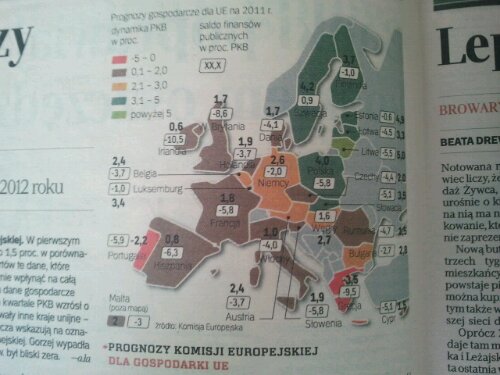
I think I’ll let the map speak for itself. It was the main story in the weekend edition of Rzeczpospolita newspaper.

Liability of Polish company Management Board members – TGC Legal Alert


Warsaw skyline from Pole Mokotowskie
Warsaw Skyline - TGC's new office is near the left side.
 
 TGC corporate lawyers have sent in the following reminder of legal responsibilities of directors in Poland that are often overlooked. Please take a moment to ensure you know the following if it impacts on you.
Dear Quoracy.com subscribers,We would like to draw your attention to the liability of members of the management board in Polish companies, as regulated by a number of legal acts. Management board members bear civil liability, criminal liability, liability for tax obligations, liability to the Social Insurance Office and liability resulting from specific provisions (e.g. resulting from the Accounting Act – Journal of Laws of 2009, no. 152, position 1223).According to the provisions of the Commercial Companies Code (Journal of Laws of 2000, no. 94, position 1037) members of the management board bear civil liability for actions taken on behalf of the company already at the stage of establishment of the company, i.e. from the date of signing of articles of incorporationof the company. This applies even before registration of the company with the State Court Register.It should be noted that members of the management board bear civil liability towards the company, among other things, for any damages inflicted upon the company in result of the management board members’ activities or omissions contrary to the articles of incorporation. Furthermore, they are jointly and severally liable for the company’s liabilities when enforcement proceedings against the company have proven ineffective.

Criminal liability of members of the management board arises as a result of a property damage caused to the company.

Apart from civil and criminal liability, members of the management board are jointly and severally liable for tax arrears, as well as for lack of (timely) payment of contributions to social insurance. It has to be noted that this type of liability lasts even after deletion of the company from the State Court Register.

In most cases members of the management board may protect themselves against responsibility for the company’s liabilities on condition that they undertake appropriate preventive activities in due time.

We will be happy to give you any detailed information with regard to the liability of the management board members, as well as circumstances of release of the liability.

For further information please contact our expert:

Agata Pastuchow-Brzezińska
Director of Corporate Department
T: +48 22 653 3649
E: apastuchow

TGC Corporate Lawyers
ul. Królewska 27
00-060 Warsaw, Poland
T: +48 22 653 3644
F: +48 22 827 6915
E: tgc
W: http://www.tgc.eu

We are moving!From 1st May 2011our new Warsaw office address and phone numbers will be:Crown Tower
ul. Hrubieszowska 2, 01-209 WarsawTelephone: +48 22 295 3300
Fax: +48 22 295 3301

It pays to avoid the BBBs (Bargain Basement Bookkeepers)


Violent Storm Strikes Western Europe
Is a storm brewing over your books and records?

I am writing to relate a story based on true events which came to light last week when one gentleman came into one of our offices and spoke to me. To keep matters confidential, I won’t say the country – the same can happen in any country – or identify anything about this company the gentleman had – even the sector. It can happen to many sectors.

This gentleman had given his company bookkeeping and tax affairs to an outsourced book-keeper for his business in that particular country. He used outsourcing back home in his own country (I’m not saying where that is either) and he appreciated the benefit of being able to have his bookkeeping professionally handled by experts without needing to employ anyone, worry about holiday cover, etc etc.

Some time ago this gentleman had included our firm in his search, and we gave him a price entirely fair for a company with our niche in the market, that is, internationally trained people, with English, with proper quality assurance, supervision and back-up.  In other words,  a peer-reviewed, branded service tailored absolutely to the needs of West European businesses in the middle tier coming to start up in East Europe, and also very good for businesses not exactly in the middle tier and from places outside West Europe.

That means that the fee offered was not nearly as high as a Big Four service would cost, but certainly higher than a purely local service.

Now I’m not knocking the purely local services – many of them are very good, but for purely local clients as they don’t tend to be claiming proficiency in foreign languages or have the ability to engage cross-culturally with the client (a source of just as many miscommunications as the language barrier on its own). They are not a great fit with the international client, and often their cheaper price becomes a false economy as frustrations rise on both sides of the desk.

The problem in this case wasn’t lack of English – this gentleman’s chosen bookkeeper spoke English, apparently.

But she was in business just on her own. With no back-up employees, probably very little insurance, probably very few resources to turn to, and very few overheads hence enabling a price no quality firm could ever compete with. That was the price that tempted this gentleman to take her bid over mine.

But since then, it became apparent that this bookkeeper was not entirely what she seemed to be.

Neither this gentleman nor myself are qualified psychiatrists, and we could only speculate on what might have gone wrong, or been wrong all along with this person. The fact is, though, that mental illness happens in the human population. We’ve probably all had employees or acquaintances who have had a mental illness, and in a larger company they quickly get noticed by colleagues, and steps taken to look after them and safeguard the clients’ affairs. When they are on their own, no such controls exist.

Suffice it to say this lady no longer was answering emails or picking up the telephone when he was calling, and when he rang from another number she didn’t know, she put the phone down when she heard his voice – the person entrusted with his company’s books and records and processing a VAT reclaim for more money than she would normally earn in many years. As you can see, the situation is now much harder – and therefore more costly – for us to repair than if he had simply given us the work in the first place.

It simply doesn’t pay to use these Bargain Basement Bookkeepers. You know what you get if you pay peanuts, and if a price looks too good to be true, it probably is.

Dlaczego potrzebujemy RMUA u lekarza?


Logo of the Social Insurance Institution of Poland
Poland's Social Insurance logo

In the following article produced for the benefit of their clients but included here for general interest, is an article by one of Luxmed’s experts showing why it is that in Poland even privately insured patients still may be required by their doctor to possess proof of social insurance under certain circumstances.

Witam,

Zgodnie z Ustawą o świadczeniach opieki zdrowotnej finansowanych ze środków publicznych, lekarz ma prawo odmówić wystawienia recepty na leki refundowane, jeżeli Pacjent nie przedstawi dowodu aktualnego ubezpieczenia. Takim dowodem może być każdy dokument potwierdzający prawo do świadczeń opieki zdrowotnej finansowanych ze środków NFZ, w szczególności dokument potwierdzający opłacenie składki ubezpieczenia zdrowotnego. Continue reading “Dlaczego potrzebujemy RMUA u lekarza?”

Article par David James et Lucia Rablova dans l’Entreprise, Decembre 2010.


Golden Charles of Praha
"Golden Charles of Praha" by Éole via Flickr

David James et Lucia Rablova de Baker Tilly Tchequie ont ecrit cette article avec Mme Valerie Malnoy de Baker Tilly France, qui est apparu dans l’edition de decembre 2010.  Nous esperons que ce contient sera interessant pour nos lecteurs francophones.

Les firmes associes de Baker Tilly sont a meme de servir des clients francophones en francais dans le plupart de la region de l’Europe de l’Est.

2010-12-08~1527@L_ENTREPRISE Rép Tchèque

Et ici vous trouverez le site de Baker Tilly Republique Tcheque en francais.